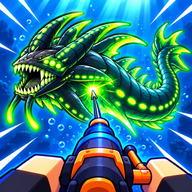
Harpoon a Fish fish index: Collection Facts and Tips for Finding New Fish
Explore confirmed Harpoon a Fish fish index details, the 1,800+ fish claim, deeper-water discovery, and practical collection-tracking tips.
What the Harpoon a Fish Fish Index Includes
Harpoon a Fish advertises more than 1,800 unique fish, making collection a major goal rather than a side activity. Knowing what is confirmed—and what still needs checking—helps you plan your hunt without relying on invented spawn locations or rarity charts. This Harpoon a Fish fish index guide covers the documented collection mechanics and a practical way to track your discoveries.
The official Roblox game description, captured on October 18, 2026, explicitly encourages players to complete their index. It also connects deeper exploration with discovering new sea monsters.
The important limitation: the description does not provide a species-by-species fish list. The advertised 1,800+ figure establishes the collection’s scale, but it does not explain how that total is divided among species, evolved forms, or other variations. Treat it as an advertised total, not a verified checklist of named entries.
Confirmed Mechanics That Matter for Collecting
The official description outlines several connected activities: catching fish with a harpoon, reaching deeper water, competing for catches, evolving fish, and raising them in an aquarium.
| Feature | What the official description confirms | What it does not establish |
|---|---|---|
| Fish index | More than 1,800 unique fish are advertised | A complete list of names or entry requirements |
| Harpoon fishing | Players aim, fire, and time their reels | Exact controls or timing windows |
| Deeper exploration | Increasing body size lets players sink deeper and discover new sea monsters | Specific depth thresholds or spawn tables |
| Competitive catches | Players can harpoon fish targeted by others and compete for the catch | Detailed ownership or index-credit rules |
| Fish evolution | Fish can evolve and grow | Evolution recipes or whether forms count separately |
| Aquarium | Caught fish can be placed in an aquarium and raised as pets | Growth timers or effects on index progress |
For basic fishing, the documented sequence is straightforward: aim at a target, fire the harpoon, and time your reels to bring it in. The source does not identify a particular button layout, so follow the controls shown in your current game session.
Deeper exploration is especially relevant to collection because the description directly links it to finding new creatures. However, it also warns of greater danger below. There is no verified depth-by-depth route here, and no evidence that every missing entry can be found simply by going farther down.
A Practical Plan for Tracking New Fish
Without a verified full fish list, your own observations can still make collection sessions more organized. The following are tracking suggestions, not confirmed hidden mechanics.
- Record exact names when the game displays them. Avoid substituting nicknames that could make similar catches difficult to distinguish.
- Note where you encountered each fish. Record any location or depth information visible in-game, but treat one encounter as an observation rather than proof of a fixed spawn.
- Separate sightings from successful catches. Seeing a creature, landing it, and confirming an index change are different things to document.
- Check progress after an unfamiliar catch. If the game shows an index update, record it rather than assuming every new-looking fish adds an entry.
- Log evolution separately. Note the fish before and after evolution, then check whether your collection progress changes.
- Date your notes. This helps distinguish older observations from discoveries made after a game update.
For example, if you catch an unfamiliar creature during a deeper dive, record its displayed name and the circumstances of the catch. If you later evolve it, keep that as a separate observation until you can confirm whether the index treats it as another entry.
This approach creates a useful personal checklist without turning guesses into supposed spawn rules.
What You Should Not Assume About Index Completion
Several details needed for a complete collection guide are absent from the official description:
- Individual fish names and their rarity tiers
- Exact spawn locations, depths, or encounter probabilities
- Weather or time requirements
- Evolution materials and costs
- Whether aquarium growth affects index completion
- Rewards for reaching collection milestones
The absence of these details does not mean those systems cannot exist. It means this source does not verify them.
Likewise, catching, evolving, and raising fish are confirmed activities, but their exact relationship to index credit is not documented. Do not assume an evolved fish automatically fills another slot or that aquarium growth unlocks a missing entry.
For now, the most defensible collection strategy is to practice the documented harpoon-and-reel process, explore deeper as your progression allows, and verify changes against what the game actually displays.
FAQ
How many fish are in the Harpoon a Fish fish index?
The official description advertises more than 1,800 unique fish. It does not provide an exact itemized total or explain how different forms contribute to that number.
Is there a verified complete fish list?
Not in the supplied official description. It confirms a large collection but does not name individual fish, list their rarities, or identify their spawn locations.
How do you discover new sea monsters?
The description says that increasing your character’s body size allows you to sink deeper and discover new sea monsters. Exact requirements and depth thresholds are not provided.
Do evolved fish count as separate index entries?
That is not confirmed. Fish evolution is advertised, but the source does not explain whether evolved forms receive separate entries. Check your in-game progress before treating an evolution as an additional discovery.